What WhatsApp Knows About Your Self-Chat (That You Don't)
You send yourself a message on WhatsApp. Maybe a parking photo. Maybe a bank account number. Maybe a screenshot of a conversation you want to remember. Maybe a voice note whispering something you'd never type to another person.
It feels private. It's a conversation with yourself. Nobody else can see it. End-to-end encrypted, just like every other WhatsApp chat.
But "encrypted" and "private" aren't the same thing. And the gap between them is wider than most people realize.
What WhatsApp's encryption actually covers
End-to-end encryption means that the content of your messages — the text, the photos, the voice notes — is encrypted in transit and at rest on WhatsApp's servers. WhatsApp (and by extension, Meta) cannot read the message content.
This is real. It's not marketing. The Signal protocol that WhatsApp uses is well-audited and genuinely prevents content inspection.
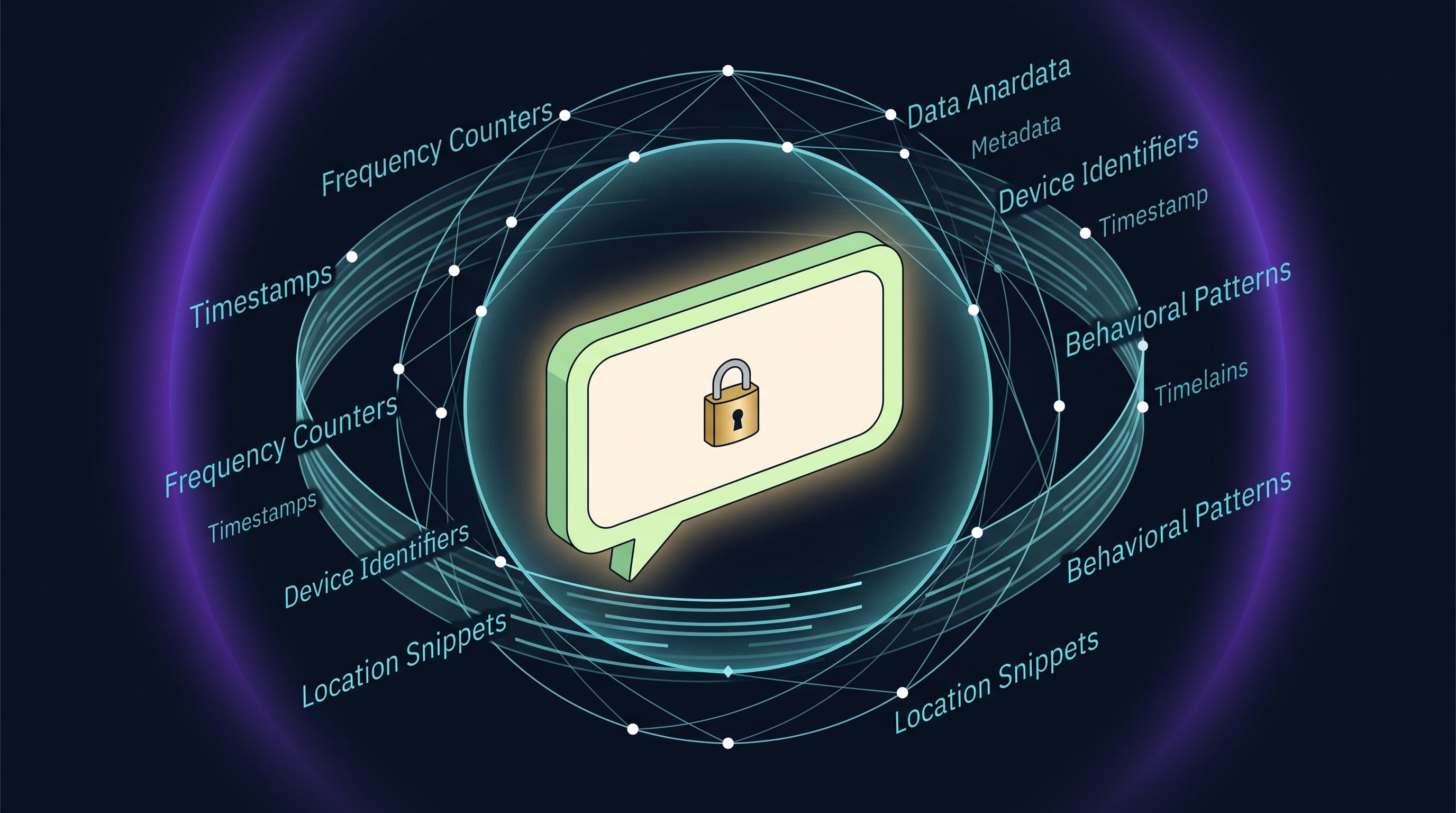
But content isn't the only data your messages generate.
The metadata layer
Every message you send — including messages to yourself — generates metadata that is not encrypted and is collected by WhatsApp:
| Data type | Encrypted? | Collected by WhatsApp? |
|---|---|---|
| Message content (text, media) | Yes | No (can't read it) |
| Who you message | No | Yes |
| When you message | No | Yes |
| How often you message | No | Yes |
| Message size/type (text vs. photo vs. voice) | No | Yes |
| Your phone number | No | Yes |
| Device information | No | Yes |
| IP address at time of sending | No | Yes |
| How often you open the app | No | Yes |
| Which features you use | No | Yes |
WhatsApp's privacy policy is explicit about this. They collect "how you interact with others on our Services, including the time, frequency, and duration of your interactions." They collect "device and connection information when you install, access, or use our Services."
Your self-chat's content is private. Your self-chat's behavior patterns are not.
What the behavior patterns reveal
"I can't read the message, I can only see the envelope" sounds harmless. But envelopes carry information.
If WhatsApp sees that you message yourself:
- 15 times per day (heavy self-saver)
- Primarily at 11pm-1am (late-night thinker)
- With a mix of text, photos, and voice notes (multi-format user)
- Increasingly with links (becoming a content saver)
- With growing message frequency over time (power user trajectory)
...that behavioral profile is useful for advertising, product development, and engagement optimization — even without reading a single word of content.
Meta's business model is advertising. Behavioral data informs ad targeting. WhatsApp is owned by Meta. The dots connect themselves.
The backup problem
Here's where it gets more concrete.
WhatsApp offers chat backups to Google Drive (Android) or iCloud (iOS). These backups are the reason your messages survive a phone change.
Until 2021, these backups were not end-to-end encrypted. They sat on Google's or Apple's servers in a format that could be accessed with a warrant, by the cloud provider, or through an account compromise.
Since late 2021, WhatsApp offers end-to-end encrypted backups. But it's opt-in. You have to manually enable it and set a password or encryption key.
If you haven't specifically enabled encrypted backups, your self-chat's entire content — every parking photo, every bank number, every voice note — sits on a Google or Apple server without end-to-end encryption.
Check right now: WhatsApp → Settings → Chats → Chat Backup → End-to-end Encrypted Backup. If it says "Off," your backups are readable by your cloud provider and potentially by law enforcement with proper legal process.
The media expiration issue
One more thing most people don't know: WhatsApp clears media from its servers after a period. That PDF you forwarded to yourself three months ago? The boarding pass screenshot? If you haven't downloaded it to your device, the media file may no longer be retrievable from WhatsApp's servers.
The text reference remains in your chat. But tapping the download icon shows a loading spinner that never resolves. The file is gone from WhatsApp's side, and if it's not in your local storage or backup, it's gone period.
Your self-chat isn't a reliable archive. It's a temporary holding area that feels permanent.
What "private" actually looks like
If your goal is genuinely private notes-to-self, the gold standard looks like this:
- Content encryption — the data is unreadable by anyone but you
- Metadata minimization — the system collects as little behavioral data as possible
- No cloud backup vulnerability — data isn't sitting unencrypted on a third-party server
- Media persistence — files don't expire or disappear without notice
- No advertising data model — the company has no incentive to monetize your behavior
WhatsApp gives you #1 (content encryption) by default. It offers #2 partially (metadata is still collected). It fails #3 unless you manually opt into encrypted backups. It fails #4 (media expires). It fails #5 (Meta is an advertising company).
Signal gives you #1-3 by default and #5 (Signal is a nonprofit). But Signal has a tiny user base, isn't where your friends are, and still doesn't solve #4 for large media files.
The alternative: separate your saving from your chatting
Here's the practical takeaway. The problem isn't that WhatsApp is evil or insecure. It's that your self-chat is trying to serve two purposes:
- A messaging channel (its actual purpose)
- A personal archive (what you've turned it into)
WhatsApp is good at #1. It was never designed for #2. Using it as an archive exposes your saved content to metadata collection, backup vulnerabilities, media expiration, and the inherent risks of trusting an advertising company's chat platform as your permanent memory.
The fix is separation. Keep WhatsApp for messaging. Move your "save for later" content somewhere purpose-built.
Pell is designed as a save-and-retrieve tool, not a messaging platform. Your data is:
- Encrypted (AES-256 at rest, TLS in transit)
- Not used for any AI model training (contractual, not just policy)
- Not subject to media expiration — what you save stays saved
- Not tied to an advertising business model
The save gesture is identical — you send a message on WhatsApp or Instagram. But the receiving end is built for permanent, searchable storage — not for social messaging with an ad model bolted on top.
No app. No account. The habit stays the same. The destination changes.
What to do right now
- Check your backup encryption. WhatsApp → Settings → Chats → Chat Backup → End-to-end Encrypted Backup. Turn it on if it's off.
- Download important media. Scroll through your self-chat and tap to download any photos, PDFs, or voice notes you'd be upset to lose. They may not be available forever.
- Redirect future saves. Next time you'd text yourself to remember something, send it to Pell instead. Same gesture, different destination, better persistence.
Frequently asked questions
Is the WhatsApp "Message Yourself" feature private? The message content is end-to-end encrypted — WhatsApp cannot read what you type or send. However, WhatsApp collects metadata (when you message, how often, message types, device info) that is not encrypted. Additionally, if you haven't enabled encrypted backups, your chat content may be stored unencrypted on Google Drive or iCloud.
Can WhatsApp read my self-messages? No. WhatsApp uses the Signal protocol for end-to-end encryption. The content of your messages cannot be read by WhatsApp, Meta, or anyone intercepting the transmission. However, your message metadata (timing, frequency, type) is visible to WhatsApp.
Do WhatsApp messages to yourself sync across devices? Yes. Your self-chat syncs across your phone, WhatsApp Web, and the desktop app. Messages appear on all linked devices. This is convenient but also means the data exists on multiple devices simultaneously.
Can police access my WhatsApp self-messages? Not the message content directly from WhatsApp (due to end-to-end encryption). However, if your cloud backup is not end-to-end encrypted, law enforcement could potentially access backup data from Google or Apple with a valid warrant. They could also potentially access messages from a seized physical device.
Do media files in my self-chat expire? WhatsApp stores media on its servers temporarily. If you haven't downloaded a file to your device and it's been cleared from WhatsApp's servers, it may become unrecoverable. Text messages persist, but attached media (photos, videos, documents) may show as unavailable after a period.